
Archive for the ‘Tutorial’ Category

Silk Paper

Thursday, December 10th, 2009

I am hooked on creating silk paper- so crazy am I that I had pounds of silk hand dyed to support my habit and yours!!LOL. What you don’t have the silk paper habit …. yet!

While in Houston Festival Liz Kettle did a silk paper demo during her Open Studio in the Cloth Paper Scissors section of the vendor floor- We had several converts who ran down to purchase a silk pack, stencil brush and textile medium. And for those of you who already purchased your supplies in Texas – SHOW ME YOUR SILK PAPER!! Please email me photos and I will post on the blog- what did you make with your silk paper?

I was asked to post a tutorial on how to make silk paper- here is the way I was taught. I am sure there are other options, comments, and recommendations- please add them via comments.

Step One: The materials

A pan that has a lip on it, you will use liquid and want to contain it. For demo purposes I have used an alumium cake pan. Also, silk, stencil brush ( any brush will work, but I like the stencil brush), textile medium, 2 small jars, netting/tulle.

making-silk-paper-textile-medium-stencil-brush

making-silk-paper-textile-medium-stencil-brush

Cut a piece of netting that is the length of the pan and twice the width of the pan. Lay the netting on the bottom of the pan.

making-silk-paper-pan-netting-step-one

making-silk-paper-pan-netting-step-one

Place the silk roving and or hankie thinly on the netting.
dry fibers on netting

dry fibers on netting

At this time you can trap some sequins, threads etc in the silk,  just make sure that you have covered top and bottom the extras. Fold the netting over the top. This will keep the brush from pulling the silk up and out of the pan!

In one of the jars mix a drop of liquid dish detergent and mostly water.  The 2nd jar will be a mixture of textile medium and water. The more textile medium the stiffer the silk will be- more water the softer the paper will be- but remember to not go less than 50/50 textile medium/water or it won’t stay together.

making-silk-paper-with-textile-medium

making-silk-paper-with-textile-medium

First use the liquid soap and water to wet the fibers using the brush to work it in- be rough not dainty.  Then work in the textile medium. I have been known to flip the silk over and work both sides.  Work the materials for 5 minutes and then hang the piece (with the netting still on) so air circulates top and bottom in order to dry quicker. Use a drip pan or paper underneath so the floor doesn’t get wet- this stuff doesn’t come up with soap and water… ask me how I know!
When the silk paper is dry the netting will peel right off.
silk paper- completed and dried

silk paper- completed and dried

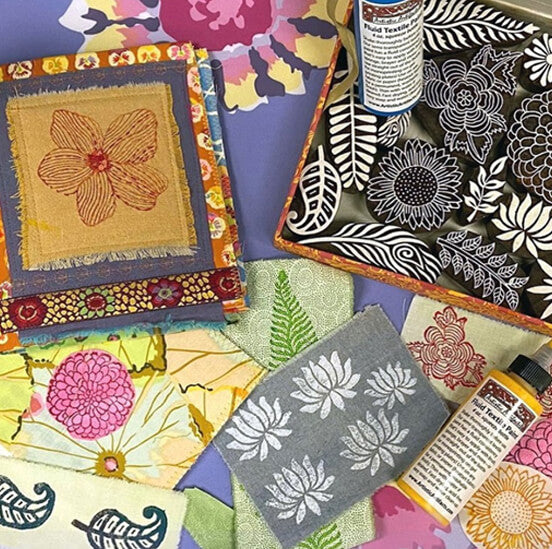
And here are the new Artistic Artifacts silk packages used in our silk paper making arti parti
making-silk-paper-kits

making-silk-paper-kits

To purchase all the supplies for silk paper making flip over to ArtisticArtifacts.com

Lutradur- What do i do with it?!?

Saturday, June 20th, 2009

Lutradur, what is it? and what do I do with it? Leave it to the talented Lesley Riley to find an out of the ordinary material that is not paper and not fiber – but can replace either easily!

Lutradur is a non woven interfacing that has BODY! And is translucent. I have played a little with it. Using Lesley Riley’s new book: Fabulous Fabric Art with Lutradur as a guide I wanted to see what photographs looked like on Lutradur. 

I used my wonderful photographs of the bridge of glass at the Tacoma, Washington Glass Museum. I took Lutradur weight 100lbs, placed it on an 8 1/2″ x 11″ sticker and ran it through my epson printer. I also printed a glass photo on the EQ cotton Lawn prepared for printing fabric. The Lutradur gave the print an abstract feeling, light, airy and without details. Hold it up to the light and you can see through the Lutradur. The cotton lawn a finely woven fabric gave great details. What else can I do? In Lesley’s book she shows samples of treated Lutradur, either before or after printing.  Seal the Lutradur with matte medium and or gesso first, then print. This one I goofed and actually had to email Lesley and ask what I was going wrong.- When putting a medium, gesso, and/or paint on the lutradur, in order to maintain the translucent quality….. you MUST water the medium down, A Lot! I swear I read the book…..some of it … the photos are very instructional…did I really need words?? My gesso sample did not work at all. But I did add matte medium to printed Lutradur after the fact and it sharpen up the photo a bit.

Another trick is to paint, foil, it and lace the Lutradur, all of which create very cool treatments. To create a lace effect on the Lutradur you wave a heat gun slowly over the Lutradur and it will disintegrate quickly.  For every treatment, gesso, medium, paint, foil, etc that you add to the Lutradur will create a resist/protection to the heat.

My first project with Lutradur was creating a screen. In Laura Cater-Woods’ class Off the Wall we created double sided screens. I fell in love! Laura will return the Artistic Artifacts Annex for a 3 day intensive Off the Wall class. You can register on line via the website or send me payments to hold your spot!

Link:

lutradur-screen.jpg

lutradur-screen3.jpg

Lutradur, printing photos on fabric, paint

 This quilt is assembled with a gel print on the left side which was printed with acrylic paints and red batik fabric. The next layer is yellow painted lutradur that I held a heat gun on it to create the lacy effect. The photo is a vintage fabric postcard printed on EQ Cotton Lawn. I have embellished with beads and red velvet leaves.  Lots of fun!

lutradur, painted, art quilt, printing on fabric

Created at the same time as the Red Quilt. The background is that wonderful printed marbled fabric – I free motion quilted it, highlighting the marbling before the layers were added. The yellow hand dyed fabric creates a corner bottom left, blue painted and heated lutradur to create lace then the green wonderful vintage hand dyed netting and photo printed on EQ Cotton Lawn.  Embellished with glass leaves, optical lens and blue hand dyed rayon fluer de lie.  Most all of these items are available for purchase, including 2 weights of lutradur on my website: www.ArtisticArtifacts.com

The Embellisher Quilts

Friday, February 13th, 2009

Previously I posted about the Artist in Residence program at Artistic Artifacts Annex where we played with our embellisher machines. I actually got on a roll and made several small quilts combining wool and cotton.  I would take 8″x10″ piece of felt and just embellish with fabric scraps, yarns, silk, etc and create a new fabric. From that piece I cut my hearts or motifs.  The Hearts were beaded, it is easier to sew on beads without additional layers and the wool embellished piece is strong enough to hold the beads without interfacing.   I use bead mixtures, silamide thread, and beading needles shorts size 12 to sew my beads on. YES, these items are for sale on my website and more!. And I am one of those people who ALWAYS sews my beads on. No glue for me!

Silamide is available in many colors: http://www.artisticartifacts.com/mm5/merchant.mvc?Screen=PROD&Store_Code=A&Product_Code=SAqua&Category_Code=bbm

Also, Bead mixtures are available in many colors: http://www.artisticartifacts.com/mm5/merchant.mvc?Screen=PROD&Store_Code=A&Product_Code=74&Category_Code=bbm

The next step is to create a center section which will have a cotton boarder on it. I chose wools that I hand dyed, (I have more to add to my site, right now check out: http://www.artisticartifacts.com/mm5/merchant.mvc?Screen=PROD&Store_Code=A&Product_Code=9001&Category_Code=wf

square of wool felt, netting and/or paper to create 2-3 layers. I would test out the look by adding charms, or buttons. Then  choose a cotton to use in a basic log cabin boarder around the center section of wool.  BEFORE sewing my heart and layers on I sewed the boarders onto the wool center section, cut batting to size, and backing,  sewed a pillow case finish.  Trimed and turned right side out, Pressed. Then I placed the heart with layers on and machine stitched it to the quilt with a decorative stitch. I decided that the boarder needed some straight stitching to hold it in place and added that.  I do not stitch in the ditch, I make it obvious that the stitching is there. (I read that in a book somewhere)

blog-red-heart-with-fatima.jpg 

This one has some wire mesh embellished in there. http://www.artisticartifacts.com/mm5/merchant.mvc?Screen=PROD&Store_Code=A&Product_Code=20002&Category_Code=

This is my parents Valentine’s Present. It is on it’s way to them now. Mom close your eyes!!

blog-elinor-and-her-heart-q.jpg

Here is Elinor holding her Birthday Present. Elinor is my college roomate and one of my best friends- she is the first one who bit the dust and turned the big 50! Happy Birthday Elinor!! Her party was a big surprise!! Good job everyone!

blog-red-heart-blue-quilt.jpg

Here is one in process…. maybe it will live in my house…… when I finish it. Maybe it will live at Rhonda’s house

blog-purple-flowers.jpg

This is a little different. I made the flower section by hand needle felting, beading and embroidery.  The first boarder out is gel printed fabric, and the final boarder is hand dyed cotton.

I am very excited about mixing fabrics!! Thrilled with the fabric that my embellisher creates.  Also, I have dyed more wool fabrics and can’t wait to see what comes next. I will even share some with you and have added hand dyed wools to my website.

How do you combine different fabric contents and textures?

Fabric Collage.. and what to do with it.

Tuesday, December 9th, 2008

I actually had some time on Sunday afternoon to hang out in my studio. It had not happened in a long time, so I really didn’t know what to do with myself. I was steps away from having a clean studio to photograph… oh what the heck!

I love to create collage fabrics. It is relaxing to me and I have many uses for it. So as Beryl Taylor says, start with making bits!

In my studio I have several drawers that hold scraps of fabric sorted by color- I pick a drawer and take it to my ironing board.

Next I cut a piece of steam a seam 2, about 12″x 14″.  (I stock it by the roll for Artistic Artifacts Annex 12″ wide, $4.50 per yard.)  Steam a seam2 has paper on both sides and is sticky, – it works better for this technique than other fusibles by holding the fabric scraps in place.

I peel one piece of paper off and lay on the table sticky side up.  Start pulling scraps out of the drawer, iron them, (I guess you don’t really have to iron them) and start in the middle and work out towards the edges.(or begin anywhere you want!)  The fabric scraps should be in one layer with minimal overlap. Once the steam a seam is completely covered with scraps, place the paper over it and iron.  At this point you will need to decide on a backing, either muslin if making book covers or peltex/timtex if making postcards, ATC’s and for my pins.

Peel off the last remaining paper and iron to your “backing”.

blog-collage-no-free-motion.jpg

Before I free motion sew my collage I will place yarns, ribbon and/or netting over top. It does not matter if it moves around, this is a collage. I frequently have the cut the netting because it gets stuck in my machine foot. but it doesn’t matter!

Choose your thread and head to the machine for free motion. The fabric can help with the free motion by just following the graphics. Anything goes!!

blog-collage-free-motion-fr.jpg

Once, the free motion stage is finished. I pull out my vintage buttons, beads, laces etc and begin to cut the collage in to pieces to create pins.

Here is a piece in black and white:

blog-collage-free-motion-bl.jpg

Check out the back:

blog-collage-free-motion.jpg

And the beginning of my pin shapes:

blog-pin-shapes.jpg

The pins have more work, ultra suede on the back, pin backing, and beading around the edge. That will take a little longer than a Sunday afternoon.

I do have a line of fabric jewelry, including necklaces, earrings, bracelets and pins that I sell on my website (needs updates) and at the Potomac Craftsmen Gallery located in the Torpedo Art Center in Alexandria, VA.