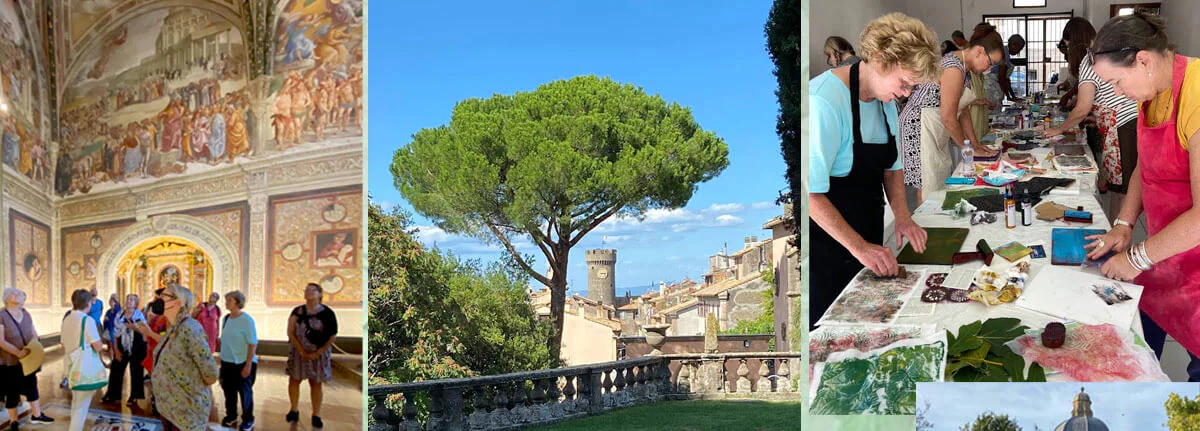

If you missed the June meetings of the Altered Minds Group at the Annex; then you missed a great session. Laura Hummel was our creativity coach and session leader. Laura had recently completed a fabulous online class with Roben Marie-Smith and she was anxious to show us how to use Liquetex acrylic inks and Adirondack Color washes. Judy cover the table with paper and Laura covered the table with inks, spray bottles, vintage papers and much more. We put on our aprons and had a blast transforming plain old boring file folders into exciting works of art!!!
JUNE ALTER MINDS
July 24th, 2011American Patchwork and Quilting Radio Hosted by Pat Sloan
July 21st, 2011I am very exicited to be Pat Sloan’s guest on Monday July 25th 4pm Eastern. You can listen on your computer, subscribe by itunes (search American Patchwork & Quilting) or download to a player.. it’s great!
http://www.allpeoplequilt.com/radio/index.html
Check out Pat Sloan’s website: http://www.creativetalknetwork.com/
Grab a cold drink and join us for a chat!
Raggedy Roses by Elizabeth Woodford
July 9th, 2011
In May, Judy’s Altered Minds artists made the coolest raggedy roses! With strips of fabric, some felt, and a needle and thread, Elizabeth demonstrated the basics and let us roll. And roll we did, curving the fabric around and around, tacking it down and rolling some more. Adding leaves, lace, buttons, beads, and more gave uniqueness to everyone’s creation. Raggedy roses can be pins for celebrations such as birthdays, attached to a hairclip or a shoe clip, or adding to art quilts…the possibilities are limited by one’s imagination. Samples of Elizabeth’s work are in the photo.
Elizabeth Teaches several fiber and jewelry workshops at Artistic Artifacts Annex Workshops. See our website for current listings. She also has a wonderful blog: Elizabeth Creates
Several in the group had attended Art & Soul, a mixed media retreat in Hampton, VA so our show and tell was buzzing with new ideas, class projects and future applications. Future Art and Soul retreats are held in Portland, OR (Sept 26-Oct 2, 2011; Sept 30/Oct 6, 2012) and Virginia Beach, VA (March 1-6, 2012). Our own Judy Gula’s Artistic Artifacts provide the retreat participants great shopping fun.
In June we will combined with the Burke QU Art Quilt bee, making name tags and have a participatory demo of alcohol inks.
Fabric Bracelet by Jenn
July 1st, 2011
Jenn is one of my many favorite Quilting buddies- she has a creativity that is non stop crazy wonderful!!
This is her post:
I’ve been obsessed lately with finding ways to incorporate fiber into my jewelry projects. I created these nifty bangles decorated with cool objects from the Jim Holtz Idea-ology line, vintage mother-of-pearl buttons and other bits and beads I find here and there. They are constructed in layers- silk scraps over canvas stitched with thread, with Timtex centers and felt insides. My favorite detail is the random embroidery stitching that finishes them. I wear them in stacks and love creating them to match my whim and fancy!
And Guess what!?! All of these products are avaiable at Artistic Artifacts Annex and Web!
Okay Okay Okay I have it all to create these bracelets-…. but not on the site yet….. will add email me if you are ready before I am! judy@ArtisticArtifacts.com
Studio Tech Basics with Cyndi Souder
May 19th, 2011This month’s Studio Tech Basics class was Tsukineko Inks- we had a full house on Tuesday for the class- Elizabeth jumped right in to take photo’s – she got some great one’s of Cyndi in Action. But we forgot the class full of students LOL! Usually Elizabeth sends me photos and it takes years for me to get them posted, but here we are.
First Studio Tech Basics with Cyndi Souder are a series of class designed to provide basic techniques that can be used in a variety of ways. Each class will highlight a specific product or technique, providing hands-on experience and lots of resources for further exploration. This winter and spring, we will concentrate on surface design tools and techniques. Let us know if you have special topics you’d like us to add to our list! In the next few days we will be adding Studio Tech Basic workshops to the website, including Angelina, Discharge, Stencil, Beading on Fabric Basics Please register early in order to assist us in planing the workshops and supplies.
Okay back to Tsukineko Inks.
Tsukineko Inks seem so mysterious, but they are really easy to use. In this 3-hour class, you’ll use them straight from the bottle and you’ll mix them with aloe gel for a different effect. You’ll rediscover the fun of “coloring” and we’ll brainstorm how to use these beautiful inks in your work.
So here is Cyndi
- Tsukineko Inks
- woo that is a great idea!
- Tsukineko Inks
- Tsukineko Inks
Does anyone remember the flip books? cut out pages and draw photos and when you flip them they show action. Our own little animated book- well I think if we cut these photos out we would have our own Cyndi Flip book!
Join Artistic Artifacts mailing list to receive future Studio Tech Basics workshop schedules: www.ArtisticArtifacts.com mailing list is bottom left side!
New Tutorials Page!
March 22nd, 2011In order to make it easier to find the great tutorials we have been posting I have added a new page called ‘Tutorials’! Look over on the right side of the blog page under the title ‘Pages’. Click on the ‘Tutorials’ link and you will find a great new image transfer tutorial by Liz Kettle using water soluble paper. Go check it out! And, because my readers are so awesome you will also find a YouTube video demoing the same technique. Let us know what you think.
Visual Journaling with JoAnn Conroy
March 7th, 2011I’m on a mission to get more people journaling, particularly women, who tend to have most of their personal time squeezed into tiny corners and no one will ever know what their lives were like after they are gone. We need more HERSTORY to balance all that HISTORY out there, and something more permanent than Tweets, emails, Facebook posts. A journal is a conversation you have with yourself, about yourself. It’s a perfect UPCYCLING project and can be done your way – and no one has to read it if you prefer it that way. There are no rules unless you want to make some. How often do we get to say THAT?
I use my journal to write letters to myself, to my future self, about what I am seeing now, feeling now, wanting to create right now. I have kept a journal since I was about 10 years old. In those days it was called a diary of course. I have boxes and volumes of spiral and composition notebooks recording my life as a student nurse, young mother and aspiring artist. When I go back to read them they are interesting but all of those words quickly start to blur and make me kind of sleepy…
Some years ago I discovered that if I incorporated color and little doodles, and simple drawings (I have never considered myself able to draw well) and glued some of my daily “flotsam and jetsam” onto the pages, I created a more compelling record for myself. I found that through this practice I was far more able to recall many more specific details of these times and places than when I simply used words. This is especially true of the emotions I was feeling at the time. I found I needed to write less to say more. Colors and images captured just the right feeling I wanted to convey. So it is no surprise that my beloved collection of juicy, over-stuffed journals gets lots of attention while my boxes of spirals are gathering dust! (My drawing ability has improved too!)
I’m teaching a journaling basics class at Artistic Artifacts Annex on Sunday March 20th. I will share all kinds of juicy information about journal-keeping (which is really HOT right now), lots of helpful books and sources, and give people a chance to try some of my favorite techniques. We’ll be making a single “signature” to use as a practice journal/note-keeping place while discussing how to choose the right kind of journal for you. Upcycling and re-purposing will be encouraged! You only need to bring a few inexpensive supplies and Judy will have lots of extra goodies available in her shop as well for those wishing to add another level of fabulousness.
Registration is easy on line, LINK or via phone: 703-823-0202 ext 213
I hope to see you there!
A Plethora of Pinked Hearts ~ by Liz Kettle
February 11th, 2011
I never used to be a ‘heart’ person. When I was in my formative art years, hearts were passé, trite and so unsophisticated. I was forced into using hearts because it is a great shape for teaching techniques; simple, recognizable, everyone can draw one, perfect for appliqué with curves with both inside and outside points and most people like them. Somewhere along the way I realized that even if they were trite in the ‘serious’ art world I had fallen in love with them! I make my art to please myself these days so even if the sophisticated shock artists of the world roll their eyes and dismiss me as trite…I am contented with my hearts.
Just like we often dismiss simple shapes we dismiss utilitarian tools or stitches. Take the lowly pinking shear…designed to help prevent fraying at the edge of fabric, very utilitarian…of course, most seamstresses found the little zigzag edge appealing but didn’t often call upon that cuteness for decorative effects. I have always loved rickrack and pinked edges so when I wanted to make a woven fabric base with just a little more pizzazz than normal for my hearts I grabbed those pinking shears and well…I fell in love yet again! How could I resist that little zigzag edge?
Weaving fabric is another often overlooked technique that is simple and low tech but gives you a wonderful intricate look. Using the pinking shears for the woven fabric strips gave me the bonus texture I was looking for and also made it easier to weave my strips together. I thought for a moment that it might be going over the top but I went for it anyway and pinked the edges of my hearts for an easy finish that doubles the cuteness factor. I got a little carried away with possibilities for this plethora of precious pinked hearts. For most of these projects you don’t even need a sewing machine so they would make great group projects. I hope one or two of them inspire a little woven and pinked love in your creative life.
Supplies
- Fabrics: 2-4 fabrics that blend or contrast. Fat quarters work well or you could even use scraps.
- Havel’s Pinking shears
- Misty Fuse or other fusible web and a Teflon pressing sheet
- Craft felt-I used white cut 12”x17” Your can be smaller or larger depending on how many hearts you desire
- Pearl Cotton or embroidery floss and embroidery needles
- Marking pencil and ruler
- Ribbon for the heart banner and poly fiberfill for stuffing puffy hearts
Steps for making your woven fabric base
1. Use the ruler and marking pencil to draw parallel lines on your fabric ½” apart. I drew 12-15 lines on each of 3 different but blending fabrics. You can get a different look by using contrasting fabrics

- 2. Use pinking shears to cut along each drawn line. With this project you don’t have to stress about getting perfectly even strips so don’t worry if you don’t cut exactly on the line every time.
3. Make a big pile of pinked strips…isn’t it yummy???
4. Cut Misty Fuse to the same size as your felt base. Place on the felt and cover with a Teflon pressing sheet. Iron to fuse the web to the felt.
5. Place pinked strips of pink fabric directly on top of the misty fuse/felt in parallel rows. Place them closely together but a little bit of white space is ok.
6. Use the iron to fuse about a ½” edge of strips on one side only. Be careful not to fuse more than about a 1/2”.
7. Peel back every other strip of pinked pink fabric to the right. We will call this the warp row
8. Place a strip of pinked pink fabric vertically on top of the remaining rows. This is the weft row.
9. Replace the strips of warp fabric that you moved to the right. Now peel back the other rows of warp strips.
10. Place another weft strip vertically. Replace the warp strips. Alternate the warp strips that you peel to the right. Use a pin or your fingernail to scoot the fabric strips together snuggly if needed.
11. Use a hot iron to fuse the woven fabric to the felt.
12. Make a heart template out of paper or plastic. Draw the template shape on the back of the felt. I like my woven fabric to be off kilter a bit so I drew my hearts at an angle. Cut out hearts with your pinking shears. This is where you will really appreciate Havels’ pinking shears! They are lighter weight than most and cut through layers so easily you would think it was only one layer.
Now you can use your hearts in a plethora of ways! Don’t you love the word plethora? I use it as often as possible…
Pinked Heart Garland.
Steps:
1. Adhere Misty Fuse to the back of one of your plain fabrics using a Teflon sheet to protect your ironing surface. Draw the heart template on top and cut out as many hearts as you need for your banner. My banner has 5 hearts that are 4 1/2″ tall..
2. Place a heart on your ironing surface, fused side up. Place the ribbon across the heart leaving enough ribbon for tying in place.
3. Place the pinked woven heart on top of the heart/ribbon layer and fuse in place. Repeat for all your hearts. Stitch around the edge with a running stitch by hand or you can machine stitch.
Hang in a prominent place and delight everyone who sees it…they are going to smile just because it is so happy.
Puffy Pinked Heart
Steps:
1. Cut a scrap of fabric for the backing slightly larger than your pinked heart. Pin in place.
2. Stitch around the perimeter of the heart leaving a gap at the very middle of the heart for stuffing. I use a shorter stitch length when I make something that will be stuffed.
3. Cut out with pinking shears. Stuff the heart with polyester fiberfill. Stitch the opening closed by hand or machine. Add a hanging cord or give it to a stitch friend for a pincushion. Some sand or plastic beads added at the stuffing phase will make a sturdier pincushion. I added some beads at the bottom and hung it up with my vintage chandelier crystals in the studio window.
Stitched Pinked Heart Card
Steps:
- I used a premade card base for this special greeting. Cut or tear a piece of art paper slightly smaller than the card size. Stitch a running stitch around the edge with pearl cotton or embroidery floss.
- Stitch a curved running stitch on your pinked heart with pearl cotton or embroidery floss. You could also stitch flowers or other designs
- Use Misty Fuse to adhere the paper to the card base and then the heart to the paper. Add a decorative strip of fabric or other embellishments as desired.
Steps:
- Fuse a backing fabric to the back of your woven heart fabric. Trace 2 inch hearts and cut out with pinking shears. Stitch around the outside edge.
- Print conversation heart sayings on ribbon or twill tape. Directions are available on my web site in the forum or in both of my books. Cut Misty Fuse in thin strips the width of your ribbon and fuse the sayings to your hearts.
Liz Kettle is a mixed media and textile artist living in Colorado. She is co-author of 2 books, Fabric Embellishing: The Basics and Beyond and Threads: The Basics and Beyond. Liz loves teaching and sharing the joy of making stuff in her articles, classes and at her fabulous retreat, Textile Evolution. Visit her blog and website, www.TextileEvolution.com
A Marvelous Memory Book by Liz Kettle
January 31st, 2011Fabric memory books are a merging of a quilt, photo album and scrapbook. Because they are primarily made with fabric they are soft, tactile and ask to be handled and loved in a way that paper books do not. I have made these little books to commemorate a special trip, event or a special person in my life. Memory books can be made in any style and they can be embellished as much as you like. They make great gift and are always a hit with the recipient because each one is unique and personal. Best of all, they can be made in a day!
Artistic Artifacts is generously hosting this tutorial and is going to sweeten the deal here with a give away for a 5 pack of The Electric Quilt Company’s cotton lawn prepared for inkjet printing!! How cool is that? Leave a comment below to be included in the random draw for the lucky winner on Monday 2/7/11.
Supplies:
Photos to print on fabric using your inkjet printer*
Inkjet fabric sheets prepared for printing (The Electric Quilt Company)
Assorted fabrics (canvas, denim or duck cloth for the page base and others to go with your theme)
Thread to coordinate with your fabrics
Fusible web (Misty Fuse) and Teflon craft sheet or parchment paper
Rotary cutter, ruler and mat
Scissors-8” sewing
Embroidery floss or other embellishment items
*if you aren’t able to print photos on your printer you can use traditional photos printed on paper but they won’t be quite as durable.
Steps:
1. Decide on the size of your finished book. Mine is 6” high by 8” wide. Using your rotary cutter, ruler and mat, cut your canvas to the height of the page you want and double the final width. My canvas is 6” high by 16” long. I cut 3 pieces of canvas to give me 10 inside pages and a front and back cover.
2. Print your photos on your inkjet printer using a prepared for printing fabric. I prefer Premium Cotton Lawn by The Electric Quilt Company because it has a very fine weave and the photos print clear and crisp but other prepared for printing fabrics work well in this sort of project. Refer to manufacturer’s directions for rinsing and heat setting. I printed my photos at 3 ½” x 5”. If you are making a smaller or larger book you can scale your photos accordingly. At the 3 ½” x 5” size 4 photos will print on one sheet of prepared for printing fabric.
3. Cut Misty Fuse or other fusible web 8 ½”x11” and adhere to the back of your photo printed fabric. One of the reasons I prefer Misty Fuse is that it is very lightweight and doesn’t change the hand of the fabric as much as other fusible webs. It does present a challenge in photos though. If you look closely you can see the light web on the back of the photos. Use a Teflon craft sheet or parchment paper to protect the iron from the fusible web.
4. Using your rotary cutter trim the photos as desired. I wanted to keep the snapshot feel of my photos so I left a 1/8” white border around each photo. You could trim the photos to the edge or cut out around figures and images.
5. Now, gather fabrics which relate to your theme. There are no rules here. You can use a wide variety of fabrics including quilting, home décor, clothing scraps, fancy fabrics etc. My theme is my grandson Zakary. I chose boy type fabrics in bright colors. I ended up not using a wide variety of colors in my book but you can have every page different in your book if you chose. I often choose fabrics that relate to the photo.
6. Decide the order your photos will appear in the book and begin designing pages. I start with a background fabric and then choose a fabric to go directly under the photo. Often, I will add more than 2 or 3 fabrics to a page but it depends on the theme.
7. Use your rotary cutter to cut your background fabric to size or you can take the more casual route and rip your fabrics. I chose to rip my fabrics because frayed edges seemed appropriate for a little boy theme. For a no math approach to design I simply layer my fabrics and images and eyeball how big I want my pieces of fabric to be. Then, I use my 8” sewing scissors to just snip a tiny bite into the fabric where I want to rip it. You don’t want to make a big cut into the fabric or you will have a section of fabric that is cut straight and not ripped. I love how sharp these scissors are all the way to the tip. I rip fabric a lot because I love the frayed edge and it is frustrating when your scissors don’t cut at the very tip.
8. You can work on one page at a time but I usually do all of my designing at once. I lay out all the pages, in the order they will go in the book and cut or rip all of the fabrics to size. When you are happy with the page designs cut pieces of Misty Fuse for the layer of fabric that is under the photo. Build your design from the bottom page base up to your photo on top and iron to fuse both layers to the base fabric at the same time.
9. Next, I add some machine stitching. I chose to simply machine stitch around each of the photos. I used a free motion foot with the feed dogs lowered because I wanted to have a more casual feel to the stitching. You could stitch with the feed dogs up and use a straight or decorative stitch for different effects. You could stitch around each layer of fabric as well as the photo.
10. Now we are at the fun embellishment stage. I wanted to keep my book simple this time so I opted for some hand embroidery. I love how much texture you add with simple running and cross stitches. There are many ways to embellish your book. I will often print quotes or descriptions on fabric to add to my pages. You can add beads, found objects, lace, trims and so much more. At this point keep any hard embellishments clear from the edges.
11. After you have added your embellishments we simply need to add our pages to the book base. Lay out your pages in order so you don’t get confused. Cut Misty Fuse to the size of your canvas page bases; 6”x16” for my book. You need one piece of Misty Fuse for each side. Begin with the front/back cover piece. Layer the canvas with the Misty Fuse and layer your photo collages on top.
12. Iron to fuse the layers together.
13. Turn the canvas over and layer another piece of Misty Fuse and your 1st inside page collage and your last inside page collage side by side. Iron to fuse the layers together. Repeat with all the remaining canvas page bases taking care to keep your pages in order. When all the pages are finished they will be stacked on top of each other so you may want to make a note of the page order in relation to which side of the canvas they go on. It can be a little confusing your first time as you can see in the photo above the second set of pages should be flipped.
14. After all your pages are fused together you will stitch around the edge of the pages. I used a straight stitch but you could use a decorative stitch that goes with your theme. Don’t forget that your bobbin thread will be the thread that shows on the other side of the page.
15. The last step is to assemble your book. Layer the pages together in order. Double check to make sure they are in the proper order. I confess in my excitement to finish, I stitched one page upside down! That gave me an excuse to use my awesome sharp Havel’s seam ripper. Fold the book in half and press to mark your stitch line. Stitch a straight stitch down the fold line. Close the book and press again.
16. As a last little optional embellishment I like to add a strip of fabric, ribbon or trim to tie around the book. This covers any exposed canvas. I stitched a piece of yellow fabric to a piece of plaid. Lay the fabric or ribbon along the middle page. Turn the book over and tie in a square knot or bow. The perfect gift or keepsake!
The winner of the Blog Drawing is Jacquie Scuitto!! Congratulations !! Liz and Judy